Due to inclement weather our office will be closed starting at 10 AM on Wednesday, 2/19/2025. We will reopen on Monday, 2/24/2025 at 8 AM.
Categories
Blog/ News

Bone Loss Around Teeth: 5 Things You May Not Know

Your teeth can be losing the bone that supports them, and you may not feel a thing.

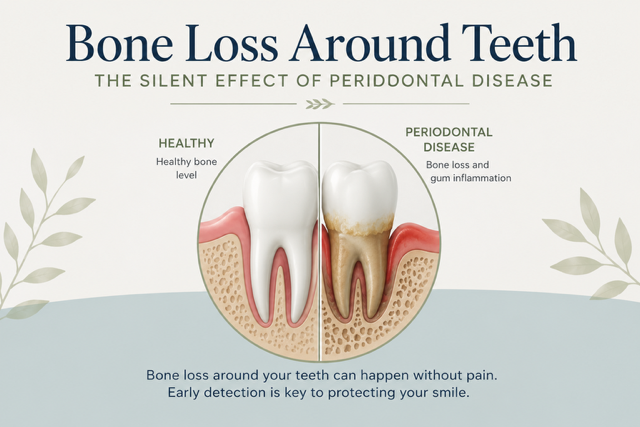
That’s one of the most surprising things about periodontal disease. Unlike a cavity that reaches the nerve or an injury that causes immediate pain, bone loss around teeth can develop quietly beneath the gumline.

Periodontitis is an inflammatory disease that can progressively damage the gums, periodontal ligament, and alveolar bone that supports your teeth. According to the American Dental Association, approximately 42% of dentate U.S. adults age 30 and older have some form of periodontitis.

So, what causes bone loss around teeth, and how can you protect your oral health?

1. Bone Loss Can Happen Without a Toothache

One of the biggest misconceptions about gum disease is that something must hurt if something is wrong. Unfortunately, pain is not a reliable early warning sign of periodontal disease.

A person can have:

– Bleeding gums

– Periodontal pockets

– Gum recession

– Bone loss

– Persistent bad breath

…and still experience little or no discomfort.

Periodontitis begins when bacteria in dental plaque trigger an inflammatory response. Over time, this inflammation can damage the tissues and bone that support your teeth.

Little-known fact: Not having pain does not necessarily mean the bone supporting your teeth is healthy.

graphic on bone loss

2. Periodontal Disease Isn’t Just About Brushing and Flossing

Good oral hygiene is essential for preventing and managing gum disease, but periodontal health involves more than how well you brush and floss.

Factors that can contribute to periodontal disease and its progression include:

– Genetics

– Tobacco use

– Certain systemic health conditions

– Medications

– Stress

– Individual susceptibility to periodontal disease

This is one reason two people with similar oral hygiene habits can have very different periodontal health.

During a periodontal evaluation, your periodontist considers the whole picture, including gum measurements, bleeding, recession, tooth mobility, bone levels, medical history, and individual risk factors.

Little-known fact: Your risk for periodontal bone loss is influenced by much more than your toothbrush and floss.

3. Dental X-Rays Can Reveal Bone Loss You Can’t See

You can look closely at your teeth and gums in the mirror and still have no idea what is happening around the roots of your teeth.

That’s because some of the most important structures supporting your teeth are beneath the gumline.

Appropriate dental imaging can help your dental professional evaluate the amount and pattern of bone surrounding your teeth. When periodontal disease is suspected—or when you have a history of periodontal disease—imaging can provide valuable information that a visual examination alone cannot.

Not everyone needs the same X-rays at every appointment. Your dental professional will recommend imaging based on your individual clinical needs.

Little-known fact: Some bone loss around your teeth can only be detected by examining what is happening beneath the gumline.

4. Bone Loss Doesn’t Automatically Mean You’ll Lose Your Teeth

Hearing that you have bone loss around your teeth can understandably be frightening. But bone loss does not automatically mean that a tooth needs to be removed.

The goal of periodontal treatment is to control the disease, reduce harmful bacteria and calculus, establish healthier tissues around the teeth, and create an environment that can be maintained over time.

Depending on the severity and location of the disease, treatment may include:

– Improved at-home oral hygiene

– Professional periodontal therapy

– Scaling and root planing

– Periodontal surgery

– Site-specific treatments

– Regenerative periodontal procedures in selected cases

For certain types of periodontal bone defects, regenerative procedures may help encourage the body’s natural ability to rebuild some lost periodontal tissues. These procedures may involve materials such as membranes, bone grafts, or tissue-stimulating proteins.

However, not every type of bone loss can be regenerated, and not every patient is a candidate. An individualized periodontal evaluation is important for determining the best approach.

Little-known fact: Even when periodontal disease has caused bone loss, there may be treatment options designed to preserve natural teeth and, in selected cases, regenerate some lost supporting tissue.

5. Treating Periodontal Disease Is Only the Beginning

Successfully treating periodontal disease is an important step, but maintaining your results is just as important.

Periodontitis is a chronic disease, and people who have experienced it can have an increased risk of recurrence. Ongoing periodontal maintenance can help manage that risk and protect your teeth and supporting tissues.

Long-term periodontal health typically involves:

– Regular professional periodontal maintenance

– Consistent brushing and flossing

– Managing individual risk factors

– Monitoring changes in your gums and teeth

– Regular periodontal evaluations

Think of periodontal care as an ongoing investment in your oral health, not a one-time treatment.

Little-known fact: After experiencing periodontitis, maintaining your periodontal health is a lifelong process.

Don’t Wait for Your Teeth to Hurt

The most important thing to remember about bone loss and periodontal disease is simple: don’t use pain as your warning system.

If you experience:

– Bleeding when brushing or flossing

– Gum recession

– Persistent bad breath

– Loose or shifting teeth

– Changes in your bite

– A history of periodontal disease

…it’s worth having your gums and supporting bone evaluated.

And even if your mouth feels completely healthy, a comprehensive periodontal evaluation can provide valuable information about structures you can’t see or feel.

Protect the Bone Supporting Your Teeth

At North Raleigh Periodontics and Implant Center, Dr. Macon Singletary and our team are committed to helping patients understand what’s happening beneath the gumline and developing individualized treatment plans designed to preserve natural teeth, protect supporting bone, and maintain periodontal health.

Your teeth may feel fine today, but the bone supporting them deserves attention, too.

Have questions about bleeding gums, gum recession, periodontal disease, or bone loss around your teeth? Contact North Raleigh Periodontics and Implant Center to schedule a periodontal evaluation.

To find out more, listen to these episodes of the Gum Guru Podcast:

For more information, email us at [email protected]. Your smile deserves specialized care – let us help you achieve and maintain optimal gum health. Serving the greater Triangle area – Raleigh, Cary, Apex, Clayton, Rolesville, and Wake Forest.


Categories
Blog/ News

Could Better Sleep Be Just a Few Minutes Away? Discover NightLase® Laser Therapy for Snoring and Sleep Apnea

If you or someone you love struggles with loud snoring, restless nights, daytime fatigue, or poor-quality sleep, you are certainly not alone.
Millions of Americans suffer from sleep-disordered breathing, including obstructive sleep apnea (OSA), often without realizing that their symptoms may be related to a treatable airway issue.
Poor sleep doesn’t just affect how rested you feel, it can impact your energy, concentration, cardiovascular health, mood, and overall quality of life. According to the American Academy of Sleep Medicine, millions of adults have undiagnosed sleep apnea, a condition associated with increased risks for hypertension, cardiovascular disease, diabetes, and other health concerns.
At North Raleigh Periodontics, we are committed to helping patients identify and treat sleep-disordered breathing through advanced diagnostics and innovative therapies, including NightLase®, a comfortable, non-surgical laser treatment designed to reduce snoring and improve airway function.
What Is NightLase®?
NightLase® is a leading-edge laser treatment that helps reduce snoring and improve airway patency without surgery, anesthesia, oral appliances, or downtime. The treatment uses gentle laser energy to heat the tissues of the soft palate and upper airway, stimulating collagen remodeling and tissue tightening. This tightening effect helps support the airway during sleep and can reduce the vibration that causes snoring.
Many patients report improvements after their first treatment, with continued benefits developing throughout the treatment series.
Benefits of NightLase® include:
– Non-surgical and minimally invasive
– No anesthesia required
– No downtime or recovery period
– Comfortable in-office treatment
– Treatment sessions typically last only 15–30 minutes
– Most patients complete treatment in approximately three visits over two months
– May reduce or eliminate snoring
– May improve sleep quality and daytime energy
Listen to these patient testimonials to learn more about NightLase and how it has helped these patients: 
Could Your Symptoms Be Related to Sleep Apnea?
Many people assume that snoring is merely an inconvenience. However, snoring can be a symptom of obstructive sleep apnea, a condition in which breathing repeatedly stops or becomes restricted during sleep.
Common signs and symptoms of sleep-disordered breathing include:
– Loud or chronic snoring
– Witnessed pauses in breathing during sleep
– Waking up gasping or choking
– Morning headaches
– Dry mouth upon awakening
– Excessive daytime sleepiness
– Difficulty concentrating or memory problems
– Irritability or mood changes
– Restless or non-restorative sleep
– Fatigue despite getting adequate hours of sleep
If you experience any of these symptoms, a sleep evaluation may be beneficial.
How Do We Determine If You Are a Candidate for NightLase®?
At North Raleigh Periodontics, we begin with a comprehensive sleep consultation to better understand your symptoms, medical history, airway anatomy, and sleep concerns. We also offer convenient take-home sleep testing, allowing many patients to be evaluated from the comfort of their own home.
You may be a candidate for NightLase® if you:
– Experience snoring that affects your quality of life or your partner’s sleep
– Have mild to moderate obstructive sleep apnea
– Are seeking a non-surgical treatment option
– Prefer to avoid or supplement CPAP therapy
– Are looking for a treatment with little to no downtime
– Have been diagnosed with sleep-disordered breathing through appropriate testing
Our goal is to identify the underlying cause of your symptoms and recommend the treatment approach that best fits your needs.
Why Addressing Sleep Apnea Matters
Untreated sleep apnea is more than a sleep problem, it can affect your long-term health.
Research from organizations such as the American Academy of Sleep Medicine and the National Institutes of Health has linked untreated obstructive sleep apnea to:
– High blood pressure
– Heart disease and stroke
– Type 2 diabetes
– Daytime fatigue and increased accident risk
– Depression and mood disorders
– Cognitive impairment and memory issues
– Reduced quality of life
Improving your sleep can improve your overall health, energy, and well-being.
Take the First Step Toward Better Sleep
You don’t have to accept snoring, poor sleep, or chronic fatigue as a normal part of life.
Through comprehensive sleep consultations, take-home sleep testing, and innovative treatment options such as NightLase®, North Raleigh Periodontics is helping patients throughout the Raleigh area breathe easier, sleep better, and improve their overall health.
If you or someone you love struggles with snoring or symptoms of sleep apnea, contact our office to schedule a sleep consultation and learn whether NightLase® may be the right solution for you.

Schedule a Consultation in North Raleigh

North Raleigh Periodontics and Implant Center helps patients build better daily habits for healthier gums and long-term results.

Contact us today to schedule your consultation and take the next step toward better oral health.

To find out more, listen to these episodes of the Gum Guru Podcast:


For more information, email us at [email protected]. Your smile deserves specialized care – let us help you achieve and maintain optimal gum health. Serving the greater Triangle area – Raleigh, Cary, Apex, Clayton, Rolesville, and Wake Forest.


References and Additional Resources

Categories
Blog/ News Podcast

Reversing the Damage: Can You Actually Cure Periodontal Disease?

All about the Gum Guru with Dr. Macon Singletary

Serving the greater Triangle area – Raleigh, Cary, Apex, and Wake Forest.

The Gum Guru Podcast with Dr. Macon Singletary will teach you everything you need to know to keep your teeth and gums healthy. Each podcast will focus on a different topic. Check back every third Thursday of the month for the latest episode.

If you have any questions for Dr. Singletary, contact him at: [email protected]

Listen to This Month’s Podcast: Reversing the Damage: Can You Actually Cure Periodontal Disease?

Can gum disease be cured, or is it a lifelong condition? In this episode of The Gum Guru, Dr. Macon Singletary of North Raleigh Periodontics explains the key differences between gingivitis and periodontitis—and what it means for your long-term oral health.

Gum disease often begins with subtle symptoms like bleeding gums, swelling, or a persistent bad taste in your mouth. While these early signs are easy to ignore, they can indicate the start of periodontal disease. Understanding when gum disease is reversible—and when it requires professional treatment—is essential to protecting your teeth and preventing bone loss.

What You’ll Learn in This Episode:

Can Gum Disease Be Reversed?:

Learn why gingivitis is reversible with proper at-home oral care, and how early treatment can prevent permanent damage.

Gingivitis vs. Periodontitis:

Understand the difference between early-stage gum disease and advanced periodontal disease, including when to see a periodontist.

Common Symptoms of Gum Disease:

Discover what bleeding gums, inflammation, and bad breath may be telling you about your oral health.

How Gum Disease Progresses:

Explore how untreated gingivitis can lead to periodontitis, bone loss, and tooth loss—and how treatment can stop the progression.

At-Home Care and Professional Treatment Options:

Get practical tips for maintaining healthy gums and learn when professional periodontal care is necessary.

Why Gum Disease Is Called a “Silent Disease”:

Find out why periodontal disease often develops without pain and how early detection can save your smile.

Whether you’ve been diagnosed with gum disease or want to improve your oral hygiene routine, this episode offers expert insights to help you maintain healthy gums and keep your natural teeth for life.

About Dr. Macon Singletary

Dr. Macon Singletary is a board-certified periodontist in Raleigh, NC, specializing in gum disease treatment, dental implants, and laser periodontal therapy. At North Raleigh Periodontics, he focuses on helping patients understand the connection between oral health and overall health while providing advanced, patient-centered care.

Don’t Miss Out!

Visit Dr. Singletary and his team at North Raleigh Periodontics & Implant Center to learn more about this subject or give us a call at 919-518-8222.

Don’t forget to subscribe to stay up to date with all the latest dental tips and insights from Dr. Singletary.

Visit northraleighperio.com to find out about all the services
North Raleigh Periodontics and Implant Center provides!

Send your questions or episode ideas to [email protected]!

Listen to The Gum Guru Podcast wherever you stream your podcasts – Spotify, Apple, Pandora and More!
If this episode helped you, share it with someone who has a loved one in long-term care. It might make a life-saving difference.

North Raleigh Periodontics & Implant Center